Last updated 2026-07-23
TL;DR
Yes. Once BPC-157 is mixed with bacteriostatic or sterile water, it should go in the refrigerator (roughly 36-46°F / 2-8°C) and gets used within about 2-4 weeks. Unopened lyophilized (freeze-dried) powder is more stable and can often sit at room temperature short-term or in the fridge/freezer for longer storage, per general peptide-handling practice used by compounding pharmacies.
Do you refrigerate BPC-157 peptide after mixing it?
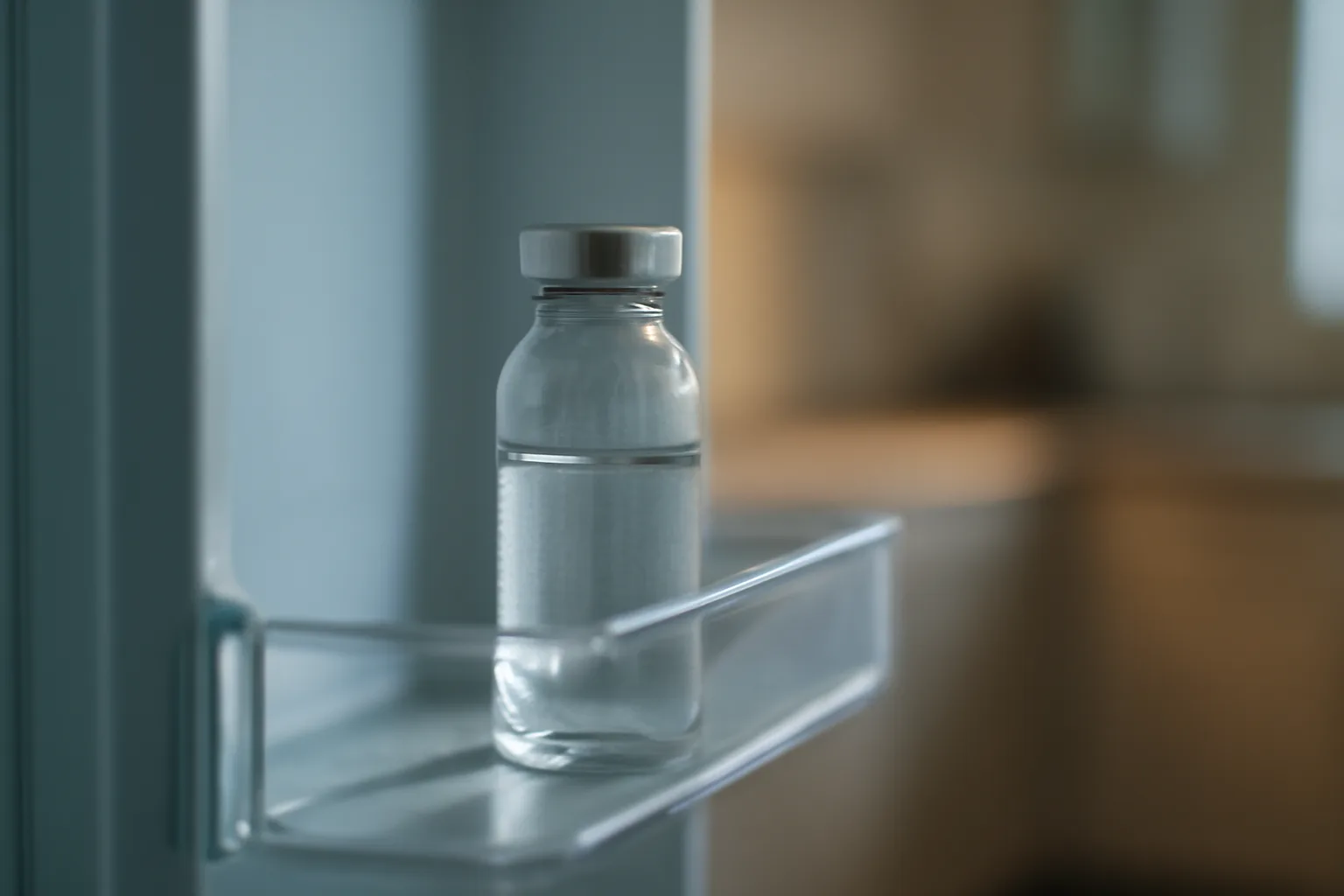
Yes. Once BPC-157 powder is reconstituted with bacteriostatic water or sterile water, it becomes a liquid solution that behaves like most injectable peptides: it degrades faster at room temperature than in the cold. Standard practice among compounding pharmacies handling peptide products is to store reconstituted vials in a refrigerator at roughly 36-46°F (2-8°C), away from light, and to use the vial within a defined window rather than indefinitely. This isn't a BPC-157-specific rule dictated by a clinical trial. There's no published human pharmacokinetic study establishing an exact shelf-life curve for reconstituted BPC-157 in a home fridge. It's the same handling logic applied across peptide compounding generally: peptides are proteins (well, short chains of amino acids), and heat, light, and repeated temperature swings accelerate the breakdown of the peptide bonds that make the molecule work. If you've ever left insulin out too long and had a physician tell you to toss it, this is the same underlying chemistry. If you're sourcing through a licensed compounding pharmacy rather than a gray-market vendor, the storage instructions should come printed or handed to you at dispensing. That's one of the real practical advantages of the provider-reviewed route: you get an actual handling protocol instead of guessing from a forum post.
How long does reconstituted BPC-157 last in the fridge?
Most compounding pharmacy guidance for reconstituted peptide products, BPC-157 included, points to a usable window of about 2 to 4 weeks under refrigeration, though some pharmacies list longer windows depending on the diluent used and their own stability testing. Bacteriostatic water (which contains benzyl alcohol as a preservative) generally supports a longer shelf life than sterile water without a preservative, because sterile water reconstitutions are more vulnerable to microbial growth over time. There isn't a universal, FDA-set expiration number for reconstituted BPC-157 because BPC-157 itself is not an FDA-approved drug. You won't find it in the Drugs@FDA database of approved products [1], and its regulatory status runs through the separate world of pharmacy compounding rather than a standard drug label with an FDA-reviewed shelf-life claim. That means the exact 'use by' window you're given is a pharmacy-specific stability call, not a number backed by a large published trial. Practical rule of thumb: label the vial with the reconstitution date the day you mix it, keep it cold, and don't stretch it well past what your dispensing pharmacy told you. If the solution turns cloudy, changes color, or shows particles, don't use it regardless of how many days are left on the clock.
Does unopened, unmixed BPC-157 powder need refrigeration too?
Unopened, freeze-dried (lyophilized) BPC-157 powder is considerably more stable than the reconstituted liquid. Lyophilization is specifically done to strip out water and lock the peptide in a stable solid state for shipping and storage, which is why nearly every peptide arrives as a powder rather than pre-mixed liquid. Many compounding pharmacies will say unopened lyophilized powder can tolerate brief room-temperature periods (during shipping, for example) without meaningful loss of potency, but that refrigeration or freezing is the safer long-term default, especially in warm climates or during summer shipping. If you're not planning to reconstitute the vial immediately, storing the unopened powder in the fridge (or freezer for longer-term storage) is the conservative move. None of this is peer-reviewed pharmacokinetic data specific to BPC-157 powder stability at various temperatures over time. It's standard peptide-handling practice carried over from the broader compounding and research-peptide industry, applied to BPC-157 because BPC-157 is chemically a peptide like any other in that category.
What temperature should BPC-157 be stored at?
| Unopened lyophilized powder | Refrigerated (36-46°F) or frozen | Months, per pharmacy-specific stability data | |
|---|---|---|---|
| Reconstituted solution | Refrigerated (36-46°F), dark | About 2-4 weeks, pharmacy-dependent | |
| Reconstituted solution left at room temp for days | Not recommended | Degradation risk rises quickly | |
| Reconstituted solution, frozen | Not recommended | Freeze-thaw stress risk | Again, these are handling conventions, not numbers pulled from a BPC-157-specific accelerated-stability trial published in a journal. Nobody has run that exact study and put it in PubMed. |
The commonly cited range is refrigerator temperature, about 36-46°F (2-8°C), for both unopened powder (if you want a stability buffer) and reconstituted solution. Freezing unopened lyophilized powder (around 0°F / -18°C) is sometimes recommended for very long-term storage before reconstitution, but once the peptide is mixed into solution, freezing is generally discouraged. Repeated freeze-thaw cycles can physically stress the peptide structure and are more likely to cause degradation than a steady fridge temperature. Here's a simple reference table based on standard peptide-handling conventions used across the compounding industry: | Form | Recommended storage | Typical stability window |
What happens if BPC-157 gets too warm or is left out?
The honest answer is that nobody can give you a precise potency-loss curve, because that specific data doesn't exist in the published literature for BPC-157. What we do know generally about peptides is that heat accelerates hydrolysis and other degradation pathways that break the peptide chain apart, which would be expected to reduce how much active peptide is actually in the vial by the time you inject it. A vial left on a hot counter or in a car during summer for a few hours is a different risk than one left out overnight repeatedly. The former is probably fine; the latter is the kind of thing that would make a pharmacist tell you to discard it and get a new vial rather than gamble on an injection that might be mostly inactive peptide fragments at that point. This is a storage and quality question, not an efficacy question. Even under ideal storage, remember that the actual evidence for what BPC-157 does in humans is thin. Most of what's known comes from rodent studies on tendon, ligament, and gut healing [2][3], not large human trials, so a perfectly preserved vial still isn't drawing on a large human evidence base.
Do you need to protect BPC-157 from light, more than heat?
Yes, standard practice is to keep peptide vials out of direct light in addition to keeping them cold. Most vials come in amber or opaque packaging for this reason, and pharmacies typically instruct patients to store vials in their original box or wrapped in foil inside the fridge rather than sitting exposed on a shelf. Light exposure, like heat, is a generic peptide stability concern rather than something studied specifically for BPC-157 in a clinical trial. It's the same reason many injectable medications (insulin included) ship in dark packaging and carry 'protect from light' instructions on the label.
Can you travel with BPC-157, and how do you keep it cold?
If you're traveling, an insulated cooler bag with an ice pack is the standard approach, the same method people use for insulin or other cold-chain injectables. A brief window at ambient temperature during a flight or car ride (an hour or two) is unlikely to ruin a reconstituted vial, but you want to minimize total time outside the fridge and get it back into refrigeration as soon as you land or arrive. If you're flying, TSA rules for injectable medications generally allow them in carry-on luggage along with the associated supplies (needles, alcohol swabs), but you should check current TSA guidance directly before travel since exact device and quantity rules can change. This falls outside peer-reviewed literature: it's a logistics question, not a research question.
Why does BPC-157 need this kind of careful handling at all?
Because BPC-157 is a peptide compounded by a pharmacy rather than an FDA-approved drug with a standardized, tested shelf-life label. It's not listed in the FDA's Drugs@FDA database of approved products [1], and its legal footing runs through the 503A and 503B pharmacy compounding framework instead. Under 21 U.S.C. 353a, licensed pharmacies can compound certain drug preparations for individual patients under specific conditions [4], and the FDA maintains bulk drug substance lists under 21 CFR 216.23 (503A) [5] and 21 CFR 216.24 (503B) [6] that govern which substances compounding pharmacies may use. That compounding pathway means there isn't a single manufacturer-tested, FDA-reviewed stability study behind every vial the way there is for, say, a name-brand insulin pen. Storage guidance instead comes from the individual compounding pharmacy's own quality practices. This is exactly why sourcing through a provider-reviewed route with a licensed pharmacy matters: you get a specific, pharmacy-issued storage protocol rather than generic internet advice cobbled together from bodybuilding forums. BPC-157 Co works with a licensed compounding pharmacy partner to dispense provider-reviewed BPC-157, and storage instructions come directly from that pharmacy at the time of dispensing rather than from marketing copy.
Does refrigeration affect how BPC-157 actually works in the body?
Refrigeration is a storage-quality question, separate from the question of whether BPC-157 does what people hope it does. On that second question, the honest picture is that the great majority of the evidence is preclinical, meaning rodent studies, not human trials. Rodent work has looked at BPC-157's effects on tendon outgrowth, cell survival, and cell migration in tendon healing models [7], its role in angiogenesis (new blood vessel formation) [8], and its interaction with growth factor pathways relevant to gut, tendon, ligament, muscle, and bone healing [3]. A 2019 review in Cell and Tissue Research summarized BPC-157's proposed role in musculoskeletal soft tissue healing based largely on this animal literature [2]. None of these dose levels or outcomes used in rodent studies translate directly into a human dosing protocol; they're mechanistic groundwork, not a green light for human use at a specific dose. Human data is much smaller and earlier-stage. A small pilot study on intra-articular BPC-157 injection for knee pain has been published in Alternative Therapies in Health and Medicine [9], and a separate small pilot study looked at BPC-157 for interstitial cystitis symptoms, also in Alternative Therapies in Health and Medicine [10]. Recent narrative and systematic reviews, including a 2025 systematic review in HSS Journal on orthopaedic sports medicine use [11] and a 2025 narrative review titled 'Regeneration or Risk?' in Current Reviews in Musculoskeletal Medicine [12], both describe the evidence base as still preclinical-dominant with only limited, small human data, and they flag real gaps in dosing standardization and long-term safety data. A 2025 literature and patent review in Pharmaceuticals also catalogs BPC-157's proposed mechanisms and patent activity without claiming settled human efficacy [13]. So: proper refrigeration keeps the peptide chemically intact until you use it. It doesn't change the fact that the underlying evidence for what that peptide does once injected is still early and mostly animal-based.
How do you know if BPC-157 has gone bad from improper storage?
Visual cues are the first check: the solution should stay clear and colorless (or whatever clear appearance your pharmacy describes as normal). Cloudiness, visible particles, a color shift, or an off smell are all reasons to discard the vial rather than inject it, the same rule used for any injectable medication. Beyond visual inspection, there's no home test for peptide potency. You can't tell by looking whether a vial that spent three days on a warm windowsill has lost 10% or 60% of its active peptide content. That uncertainty is exactly why sticking to labeled storage windows matters more than trying to judge it by eye alone. If you're ever unsure whether a vial is still good, the conservative and cheap move is to not use it. A new vial costs far less than dealing with an infection from a contaminated injection or simply injecting an inactive solution for weeks without realizing it.
What's the difference between how BPC-157 is stored and how it's dosed?
Storage is about keeping the peptide chemically stable until use; dosing is a completely separate question about how much to inject, how often, and by what route. These get confused a lot because both show up together in vendor marketing copy, often stated with more confidence than the evidence supports. On the storage side, this article covers what's known: refrigerate reconstituted solution, use within roughly 2-4 weeks per pharmacy guidance, keep unopened powder cold and dark, protect from light and heat. On the dosing side, animal studies have used specific microgram-per-kilogram doses in rats and other species, but a rodent milligram-per-kilogram dose does not scale directly to a safe or effective human dose, and no such conversion has been validated in published human trials. If you want the fuller picture on how researchers and clinicians are approaching human dosing questions given this evidence gap, see BPC-157 dosage and the BPC-157 dosage calculator, and for injection technique specifically, BPC-157 peptide injections. For the safety side of things, including what side effects have actually been reported, see BPC-157 peptide side effects.
Where does BPC-157 fit in the broader peptide therapy landscape right now?
Recent orthopaedic and sports medicine literature has started treating BPC-157 as one entry in a wider category of injectable therapeutic peptides being explored for musculoskeletal recovery. A 2026 primer in The American Journal of Sports Medicine frames injectable peptide therapy broadly for orthopaedic and sports medicine physicians, situating BPC-157 alongside other peptides under investigation [14]. A 2025 review in Arthroscopy similarly discusses injectable therapeutic peptides as a possible adjunct to regenerative medicine and sports performance care, while noting the evidence gaps across the category [15]. A 2026 paper in JAAOS Global Research & Reviews on therapeutic peptides in orthopaedics likewise discusses BPC-157 in the context of applications, challenges, and future directions for the field, again describing an evidence base still maturing rather than settled [16]. A 2026 review in Sports Medicine specifically weighs safety and efficacy questions across approved and unapproved peptide therapies used for musculoskeletal injuries and athletic performance, underscoring that BPC-157 sits in the 'unapproved' category relative to FDA-cleared options [17]. What this tells you: BPC-157 isn't unique in being early-stage and preclinical-heavy. It's part of a broader wave of peptides physicians and researchers are watching closely, with more rigorous human trials called for across the reviews rather than already completed. See BPC-157 peptide for the fuller evidence rundown.
Frequently asked questions
Do you refrigerate BPC-157 peptide before or after mixing it?
Both matter, but the reconstituted (mixed) solution needs refrigeration most urgently, typically at 36-46°F (2-8°C), and is generally used within about 2-4 weeks. Unopened lyophilized powder is more stable and can tolerate brief room-temperature periods, though refrigerating it is still the safer default for storage before mixing.
How long can reconstituted BPC-157 sit out at room temperature?
There's no published stability study giving an exact number for BPC-157 specifically. General peptide-handling practice suggests a short window (an hour or two, such as during transport) is unlikely to cause meaningful degradation, but leaving a reconstituted vial unrefrigerated for days is not recommended and risks reduced potency.
Can you freeze BPC-157 after it's been reconstituted?
This is generally discouraged. Freezing unopened lyophilized powder is sometimes used for long-term storage, but freezing a reconstituted (liquid) solution risks freeze-thaw stress that can degrade the peptide structure. Refrigeration, not freezing, is the standard recommendation once BPC-157 is mixed into solution.
What is the ideal fridge temperature for storing BPC-157?
Roughly 36-46°F (2-8°C), which is standard refrigerator temperature and the range typically cited by compounding pharmacies for injectable peptide storage. This applies to reconstituted solution and is also fine for unopened powder if you want extra stability insurance before mixing.
Does BPC-157 go bad if it's not refrigerated?
It can degrade faster without refrigeration, since heat accelerates the breakdown of peptide bonds. There's no BPC-157-specific study quantifying exact potency loss at room temperature, but standard peptide-handling guidance treats consistent refrigeration as necessary once the powder is reconstituted into a liquid solution.
How long does BPC-157 last unopened in the fridge?
Unopened lyophilized powder is generally considered stable for months when kept refrigerated or frozen, according to typical compounding pharmacy handling practice, though exact shelf life depends on the specific pharmacy's stability testing. Ask your dispensing pharmacy for the specific expiration date printed on your vial.
Should you keep BPC-157 vials away from light?
Yes. Peptide vials, including BPC-157, are generally shipped in amber or opaque packaging and should be stored out of direct light in addition to being refrigerated. Light exposure, like heat, is considered a generic risk factor for peptide degradation across the compounding industry.
How do you know if BPC-157 has degraded from poor storage?
Check for cloudiness, visible particles, discoloration, or an unusual smell in the solution; any of these means you should discard the vial. There's no reliable at-home way to measure actual potency loss, so when in doubt, don't inject a vial you're unsure about.
Is BPC-157 FDA-approved, and does that affect storage guidance?
No, BPC-157 is not FDA-approved and doesn't appear in the FDA's Drugs@FDA database of approved products. Because of this, there's no single FDA-reviewed shelf-life label; storage guidance instead comes from the compounding pharmacy dispensing your specific vial, which is why using a licensed pharmacy matters.
Can you travel with BPC-157 and keep it properly cold?
Yes, using an insulated cooler bag with an ice pack, the same approach used for insulin and other cold-chain injectables. Minimize time outside refrigeration and get vials back into a fridge as soon as possible; check current TSA guidance for carrying injectable medications before flying.
Does proper storage mean BPC-157 is proven to work?
No. Storage only affects whether the peptide stays chemically intact; it says nothing about efficacy. The evidence for BPC-157's effects is overwhelmingly preclinical (rodent studies), with only small, early human pilot studies published so far on things like knee pain and interstitial cystitis symptoms.
What's the difference between bacteriostatic water and sterile water for reconstituting BPC-157?
Bacteriostatic water contains a preservative (benzyl alcohol) that helps inhibit microbial growth, generally supporting a longer usable window for the reconstituted solution. Sterile water lacks that preservative and is typically associated with a shorter recommended use window. Your dispensing pharmacy should specify which diluent applies to your vial.
Sources
- FDA, Drugs@FDA database: BPC-157 is not listed as an FDA-approved drug product
- Cell and Tissue Research, 2019 (PMID 30915550): BPC-157's proposed role in accelerating musculoskeletal soft tissue healing, based on preclinical research
- Current Pharmaceutical Design, 2018 (PMID 29998800): BPC-157 interaction with angiogenic growth factor pathways in gut, tendon, ligament, muscle and bone healing models
- 21 U.S.C. 353a, pharmacy compounding: Legal basis allowing licensed pharmacies to compound certain drug preparations for individual patients
- 21 CFR 216.23, the 503A Bulks List: FDA regulation governing bulk drug substances eligible for 503A pharmacy compounding
- 21 CFR 216.24, the 503B Bulks List: FDA regulation governing bulk drug substances eligible for 503B outsourcing facility compounding
- Journal of Applied Physiology, 2011 (PMID 21030672): BPC-157 promotes tendon outgrowth, cell survival, and cell migration in tendon healing research
- Current Pharmaceutical Design, 2014 (PMID 23782145): BPC-157's studied role in blood vessel formation (angiogenesis)
- Alternative Therapies in Health and Medicine, 2021 (PMID 34324435): Small pilot study on intra-articular BPC-157 injection for multiple types of knee pain
- Alternative Therapies in Health and Medicine, 2024 (PMID 39325560): Small pilot study on BPC-157 effects on symptoms in patients with interstitial cystitis
- HSS Journal, 2025 (PMID 40756949): Systematic review describing BPC-157 evidence in orthopaedic sports medicine as still preclinical-dominant with limited human data
- Current Reviews in Musculoskeletal Medicine, 2025 (PMID 40789979): Narrative review flagging gaps in dosing standardization and long-term safety data for BPC-157
- Pharmaceuticals (Basel), 2025 (PMID 40005999): Literature and patent review cataloging BPC-157's proposed mechanisms and patent activity
- The American Journal of Sports Medicine, 2026 (PMID 41476424): Primer on injectable peptide therapy for orthopaedic and sports medicine physicians situating BPC-157 among other studied peptides
- Arthroscopy, 2025 (PMID 39265666): Review discussing injectable therapeutic peptides as a possible adjunct to regenerative medicine and sports performance
- JAAOS Global Research & Reviews, 2026 (PMID 41490200): Review of therapeutic peptides in orthopaedics covering applications, challenges, and future directions
- Sports Medicine, 2026 (PMID 41966639): Review weighing safety and efficacy of approved versus unapproved peptide therapies for musculoskeletal injuries and athletic performance