Last updated 2026-07-23
TL;DR
Unopened, freeze-dried BPC-157 stays stable for a long time in a refrigerator (36-46°F) or freezer, away from light. Once reconstituted with bacteriostatic water, keep it refrigerated and treat it as a peptide with a short clock: most compounding guidance and common peptide-handling practice put reconstituted stability at roughly 2-4 weeks, not months.
How should you store BPC-157 before it's mixed (lyophilized powder)?
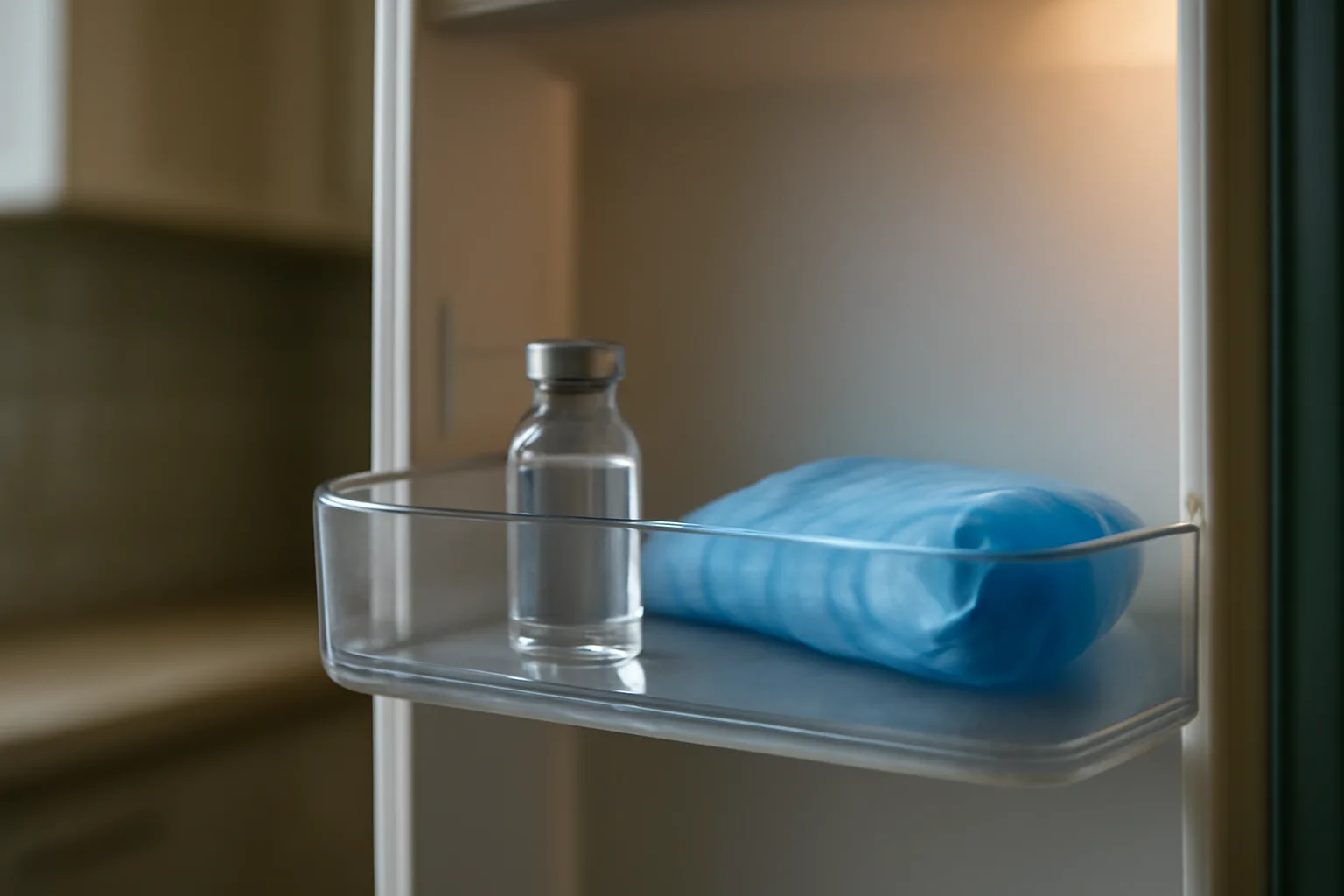
Freeze-dried BPC-157 in its sealed vial is the most stable form of the peptide. Keep it in a refrigerator between roughly 36-46°F, in the original vial, out of direct light. A standard kitchen or medical-grade refrigerator door shelf works, though the back of a shelf (steadier temperature than the door) is a little better. Freezing unopened lyophilized powder is generally fine and extends shelf life further, which is why some compounding pharmacies ship product frozen or refrigerated with an ice pack. The peptide itself, BPC-157 (body protection compound-157), is a synthetic 15-amino acid chain studied almost entirely in laboratory and animal models [1][2]. None of the clinical or preclinical papers behind that research record report on shelf-life or degradation kinetics for commercial vials, so any specific 'stays good for X months' number floating around forums is not backed by the peptide research itself. It's coming from general peptide chemistry and pharmacy compounding norms, not a BPC-157 study. What destroys lyophilized peptide fastest is heat, repeated freeze-thaw cycling, humidity, and light. A vial left in a hot car or on a sunny windowsill for even a few hours is a bigger risk than a week in a normal fridge.
How long does reconstituted BPC-157 last once mixed with bacteriostatic water?
Most peptide-handling guidance, drawn from general compounding pharmacy practice rather than BPC-157-specific trials, treats reconstituted peptide as good for about 2-4 weeks under refrigeration. Some sources extend that to 6-8 weeks for certain peptides, but the tighter window is the safer assumption for a compound with no published stability data of its own. Bacteriostatic water (water with 0.9% benzyl alcohol) is used specifically because the benzyl alcohol suppresses bacterial growth in a multi-dose vial, which matters if you're drawing from the same vial repeatedly. Plain sterile water without a preservative should be treated as single-use and discarded same-day if opened, because there's nothing in it stopping contamination from repeated needle entries. After mixing, keep the vial refrigerated, not frozen. Refreezing reconstituted peptide is one of the more common mistakes: freeze-thaw cycling can shear peptide bonds and degrade potency, so a vial that's been reconstituted should stay in the fridge until it's used up or its window runs out, then be discarded.
Does BPC-157 need to be refrigerated, or is room temperature okay short-term?
Short stretches at room temperature (a few hours, say during shipping or a day trip) are unlikely to ruin lyophilized powder. Reconstituted liquid is more fragile and more sensitive to temperature, so it shouldn't sit out at room temperature for extended periods, and never for days. If you're traveling, an insulated bag with an ice pack is the practical answer, not hoping the vial survives a warm glovebox. Airport screening and TSA rules for injectable medication and diluents are a separate practical issue worth checking directly with TSA or your compounding pharmacy before flying with any of it. Heat is the enemy here more than light exposure or a single missed refrigeration window. Repeated warm-cool cycling, or one extended hot exposure (a car trunk in summer, for example), is worse than a steady, slightly-too-warm room.
Can you freeze BPC-157, and should reconstituted vials ever go in the freezer?
Unopened lyophilized powder: yes, freezing is generally acceptable and can extend shelf life beyond refrigerated storage. Reconstituted liquid: no, don't freeze it. Freezing a mixed vial and thawing it later exposes the peptide to ice crystal formation and freeze-thaw stress, which is one of the more reliable ways to degrade a reconstituted peptide's structure and reduce how much active compound is actually left in solution. If a pharmacy or supplier ships your BPC-157 already reconstituted (uncommon, but it happens with some compounding routes), ask them directly what storage temperature they validated it at and for how long. That's a fair question to put to any licensed compounding pharmacy dispensing the product; a legitimate operation will have a documented beyond-use date rather than a vague 'keep cold.'
How can you tell if BPC-157 has gone bad?
There's no BPC-157-specific published data on visible degradation markers, so the guidance here is general peptide-handling practice, not a citation from the BPC-157 literature itself. Watch for cloudiness, visible particles, a color change, or an off smell in a solution that was originally clear. Any of those is a reason to discard the vial rather than inject it. A vial that's been left warm for an extended period, frozen and thawed after reconstitution, or kept well past its use window should be treated as compromised even if it still looks clear. Peptide bonds can break down in ways that aren't visible to the eye; clarity isn't proof of potency. If you're unsure whether a batch is still good, the safer move is to not use it and to talk to the dispensing pharmacy about a replacement, rather than guessing.
What temperature range should you actually keep BPC-157 at?
| Form | Storage | Practical range | Notes | |
|---|---|---|---|---|
| Lyophilized (unmixed) powder | Refrigerate or freeze | ~36-46°F (fridge) or 0°F and below (freezer) | Most stable form; keep in original sealed vial, away from light | |
| Reconstituted (mixed) liquid | Refrigerate only | ~36-46°F | Do not freeze; general peptide guidance suggests using within roughly 2-4 weeks | |
| Short transport/travel | Insulated, cold | As close to fridge temp as practical | Brief room-temp exposure (a few hours) is lower-risk than repeated warm-cool cycling | These ranges reflect general peptide and compounding-pharmacy handling practice. No paper in the current BPC-157 research record, including the recent literature and patent review in Pharmaceuticals [1] or the orthopaedic systematic review in HSS Journal [3], reports vial-specific stability data. If your compounding pharmacy provides a beyond-use date on the label, that date supersedes any general rule of thumb. |
Does light exposure matter for BPC-157 storage?
Direct light, especially sunlight, isn't good for a peptide sitting in solution or powder. It's a secondary concern next to temperature control, but it's an easy one to manage: keep the vial in its original box or wrapped, store it toward the back of a fridge shelf rather than the door, and don't leave it sitting on a counter in daylight between uses. There's no published BPC-157 photostability data to point to a specific number of lux-hours or an exact degradation curve. The practical habit, box-store-fridge, costs nothing and removes a variable that otherwise doesn't need to be in play.
How should you handle BPC-157 during shipping or travel?
Reputable compounding pharmacies typically ship lyophilized peptide with an ice pack or cold-chain packaging, and the product should go straight into a refrigerator on arrival, not sit on a porch in summer heat for hours. If a package arrives visibly warm or the ice pack has fully melted and the box shows signs of significant heat exposure, that's worth a call to the pharmacy before use. For personal travel, an insulated bag with a gel pack, kept in checked luggage or a cooler rather than a hot car, is the sensible approach. Long, uncontrolled temperature swings, not brief handling gaps, are what actually threaten potency. Sourcing matters here too. Peptide quality control, correct reconstitution instructions, and accurate labeling on beyond-use dating are inconsistent across the unregulated research-chemical market. Buying through a licensed compounding pharmacy rather than an unregulated research-chemical seller is the more reliable way to get a product with known handling instructions in the first place, since bulk substances used in compounding fall under FDA's 503A and 503B bulk drug substance frameworks [4][5][6].
What's the difference between storing powder vs. a pre-mixed liquid pen or vial?
Powder is forgiving; liquid is not. Lyophilized BPC-157 in its sealed vial tolerates a wider range of temperatures and a longer timeline before anyone needs to worry. Once it's reconstituted, whether you mixed it yourself with bacteriostatic water or received a pre-mixed product, the clock starts and the storage rules tighten: fridge only, no freezing, and a real use-by window rather than an indefinite one. If you're new to this and trying to figure out how much bacteriostatic water to add and how that affects concentration and dosing, that's a separate question from storage, covered in BPC-157 dosage and worked through practically in a BPC-157 dosage calculator. Storage and dosing intersect at one point worth flagging: a vial that's degraded from poor storage doesn't necessarily look different, but it may no longer deliver the concentration your calculated dose assumes.
Where does the human and animal research on BPC-157 actually stand, separate from storage?
This is worth saying plainly because storage questions tend to come from people already deep into using the peptide, and it's easy to lose track of how thin the human evidence actually is. The overwhelming majority of BPC-157 research is preclinical, meaning rodent and cell-based studies, not human trials. A 2019 review in Cell and Tissue Research describes BPC-157's role in accelerating musculoskeletal soft tissue healing based on this preclinical body of work [7]. A 2018 paper in Current Pharmaceutical Design examines BPC-157 alongside standard angiogenic growth factors in tendon, ligament, muscle, bone, and gastrointestinal healing, again from animal and lab models [8]. Older mechanistic work on BPC-157's effects on tendon fibroblast migration and outgrowth (2011, Journal of Applied Physiology) and its relationship to blood vessel growth (2014, Current Pharmaceutical Design) is likewise lab-based [5][9]. Human data exists but is small and early. A 2021 report in Alternative Therapies in Health and Medicine describes intra-articular BPC-157 injection for multiple types of knee pain [10]. A 2024 pilot study in the same journal looked at BPC-157's effect on symptoms in patients with interstitial cystitis [11]. Two 2025 reviews, one in Pharmaceuticals covering BPC-157's multifunctionality and patent landscape [1], and a systematic review in HSS Journal specifically on its emerging use in orthopaedic sports medicine [3], both note the gap between the animal literature and the amount of controlled human trial data available. A 2025 narrative review in Current Reviews in Musculoskeletal Medicine frames this directly as a question of 'regeneration or risk,' weighing the promise of the preclinical signal against how little controlled human safety and efficacy data exists [2]. More recent orthopaedic literature, including a 2026 paper in the Journal of the American Academy of Orthopaedic Surgeons Global Research & Reviews on therapeutic peptides in orthopaedics [12], a 2026 primer in the American Journal of Sports Medicine on injectable peptide therapy [13], a 2025 review in Arthroscopy on injectable therapeutic peptides as a possible adjunct to regenerative medicine and sports performance [4], and a 2026 review in Sports Medicine on safety and efficacy of approved and unapproved peptide therapies for musculoskeletal injury and athletic performance [6], all treat BPC-157 as a compound under active investigation rather than an established clinical treatment. None of this changes storage advice, but it's the honest context for anyone deciding how seriously to treat the handling instructions in the first place: this is a research peptide with an evolving evidence base, not an FDA-approved drug with a settled label. You can check any drug's approval status directly in Drugs@FDA [14].
Is BPC-157 legal to buy and store, and does that affect how it's dispensed?
BPC-157 is not an FDA-approved drug, and it does not appear on FDA's current lists of bulk drug substances eligible for use in compounding under section 503A or 503B [4][5]. Compounding pharmacies operate under distinct legal frameworks: 21 U.S.C. 353a governs pharmacy compounding generally [15], while 21 CFR 216.23 and 216.24 define the specific 503A and 503B bulk substance lists [16][17]. Whether and how a given compounding pharmacy can prepare BPC-157 for a specific patient depends on where that pharmacy sits relative to these lists and on physician oversight, not on marketing claims from a seller. This matters for storage indirectly: a licensed, provider-reviewed route through a compounding pharmacy generally comes with clearer labeling, a stated beyond-use date, and documented handling instructions. An unregulated research-chemical purchase usually comes with none of that, which pushes buyers back onto generic forum advice for something as basic as 'how long is this good for.' BPC-157 Co's fulfillment is provider-reviewed and dispensed through a licensed compounding pharmacy partner, which is the practical reason to prefer that route if you want an actual beyond-use date on the label instead of a guess.
What are the most common storage mistakes people make with BPC-157?
Leaving reconstituted vials at room temperature for days instead of refrigerating between uses is probably the single most common one. A close second is refreezing a mixed vial after it's already been reconstituted, which stresses the peptide through freeze-thaw cycling. Others worth flagging: storing the vial in a fridge door where temperature swings more with every open-close cycle, leaving vials in direct sunlight on a counter, using plain sterile water instead of bacteriostatic water for a vial meant for multiple draws (raising contamination risk since there's no preservative), and continuing to use a vial well past any reasonable use window just because it still looks clear. None of these mistakes are dramatic or immediately obvious. That's exactly the problem: a peptide that's lost potency from poor storage doesn't announce itself, it just under-delivers, which then muddies any read on whether the product itself is doing anything at the dose being used. If storage and dosing timing both need review, see BPC-157 peptide injections for the practical injection-side details, and BPC-157 peptide side effects for what to watch for.
Frequently asked questions
How long does BPC-157 last in the fridge once mixed?
General peptide-handling guidance, not BPC-157-specific trial data, puts reconstituted peptide's refrigerated shelf life at roughly 2-4 weeks. There's no published stability study specific to BPC-157 vials, so treat that window as a practical rule of thumb rather than a proven number, and defer to any beyond-use date your compounding pharmacy provides on the label.
Can you freeze reconstituted BPC-157?
No. Freezing is fine for unopened, unmixed lyophilized powder, but once BPC-157 is reconstituted with bacteriostatic water, freezing and thawing it again risks breaking down the peptide through freeze-thaw stress. Keep mixed vials refrigerated, not frozen, and use them within the recommended window instead.
Does BPC-157 need to be refrigerated at all times?
Unopened lyophilized powder tolerates brief room-temperature exposure, such as during shipping, without major concern. Once reconstituted, though, it should stay refrigerated between uses. Extended room-temperature storage of a mixed vial, especially over multiple days, raises real risk of potency loss and, without a preservative, contamination.
What happens if BPC-157 gets warm during shipping?
Brief warm exposure during transit (a few hours) is unlikely to destroy unopened lyophilized powder, especially if the pharmacy shipped it with cold packaging. Extended heat exposure, like a package sitting in a hot mailbox for a day, is more concerning. If a shipment arrives visibly warm with fully melted ice packs, contact the dispensing pharmacy before use.
How do you know if BPC-157 has degraded or gone bad?
There's no BPC-157-specific published data on visible spoilage signs. General peptide practice says watch for cloudiness, particles, discoloration, or an off smell in what should be a clear solution, and discard if any appear. A vial that was left warm for a long stretch or refrozen after mixing should be treated as compromised even if it still looks normal.
What water should you use to reconstitute BPC-157?
Bacteriostatic water, which contains 0.9% benzyl alcohol as a preservative, is standard for multi-dose vials because it suppresses bacterial growth between draws. Plain sterile water lacks a preservative and should be treated as single-use, discarded the same day if opened, since repeated needle entries into an unpreserved vial raise contamination risk.
Should BPC-157 be stored in the fridge door or the back of the shelf?
The back of a fridge shelf holds a steadier temperature than the door, which fluctuates every time the fridge opens. For a peptide vial, especially reconstituted liquid, that steadier temperature is a small but real advantage. Keep the vial in its original box, out of direct light, toward the back rather than the door.
Can you travel with BPC-157, and how should you pack it?
Yes, with care. An insulated bag with an ice or gel pack, kept out of hot cars and direct sun, is the practical approach for both lyophilized powder and reconstituted liquid. Check current TSA guidance directly for rules on traveling with injectable medication and diluents before a flight.
Is BPC-157 FDA-approved, and does that affect how pharmacies dispense it?
No, BPC-157 is not an FDA-approved drug; you can confirm approval status directly in the Drugs@FDA database. It also does not appear on FDA's current 503A or 503B bulk drug substance lists. Compounding pharmacies operate under 21 U.S.C. 353a and the 503A/503B frameworks, which shapes whether and how a given pharmacy can prepare it under physician oversight.
Does light exposure damage BPC-157?
Light, particularly direct sunlight, is a secondary concern behind temperature control. No published BPC-157 photostability data exists to give a specific degradation timeline, but keeping the vial in its original packaging, away from a sunny counter or windowsill, is a low-cost precaution worth taking regardless.
How is BPC-157 storage different from dosing accuracy?
Storage determines whether the peptide in the vial is still potent; dosing determines how much of it you draw and inject. A degraded vial from poor storage can silently undercut a carefully calculated dose without any visible sign, which is why storage habits matter even for people who are otherwise precise about their dosing math.
What's the difference between storing powder and a pre-mixed BPC-157 liquid?
Lyophilized powder is far more stable and tolerates wider temperature ranges and longer timelines before use. Reconstituted liquid, whether self-mixed or received pre-mixed, needs consistent refrigeration, no freezing, and a defined use-by window, typically discussed in terms of a few weeks rather than months.
Where does BPC-157's research evidence stand overall?
The large majority of BPC-157 research is preclinical, meaning rodent and lab studies on tendon, ligament, muscle, bone, and gut healing. Human data is limited to small, early studies, such as a knee pain injection report and an interstitial cystitis pilot study, both published in Alternative Therapies in Health and Medicine. Recent 2025-2026 reviews describe an active but unsettled evidence base.
Sources
- Pharmaceuticals (Basel), 2025 (PMID 40005999): 2025 literature and patent review describing BPC-157's multifunctionality and possible medical applications, noting the gap between preclinical findings and clinical translation
- HSS Journal, 2025 (PMID 40756949): 2025 systematic review of BPC-157's emerging use in orthopaedic sports medicine
- Cell and Tissue Research, 2019 (PMID 30915550): BPC-157's role in accelerating musculoskeletal soft tissue healing, based on preclinical research
- Alternative Therapies in Health and Medicine, 2021 (PMID 34324435): Small human report on intra-articular BPC-157 injection for multiple types of knee pain
- Current Pharmaceutical Design, 2018 (PMID 29998800): BPC-157 compared with standard angiogenic growth factors in tendon, ligament, muscle, bone, and GI tract healing in animal models
- Current Reviews in Musculoskeletal Medicine, 2025 (PMID 40789979): Narrative review weighing regenerative promise against safety and evidence gaps for BPC-157 in musculoskeletal healing
- JAAOS Global Research & Reviews, 2026 (PMID 41490200): Review of therapeutic peptides in orthopaedics covering applications, challenges, and future directions
- American Journal of Sports Medicine, 2026 (PMID 41476424): Primer for orthopaedic and sports medicine physicians on injectable peptide therapy
- Arthroscopy, 2025 (PMID 39265666): Review of injectable therapeutic peptides as a possible adjunct to regenerative medicine and sports performance
- Journal of Applied Physiology, 2011 (PMID 21030672): Laboratory findings on BPC-157 promoting tendon healing via cell survival, migration, and outgrowth
- Sports Medicine (Auckland), 2026 (PMID 41966639): Review of safety and efficacy data for approved and unapproved peptide therapies used for musculoskeletal injury and athletic performance
- Current Pharmaceutical Design, 2014 (PMID 23782145): Preclinical findings on BPC-157's relationship to blood vessel growth
- Alternative Therapies in Health and Medicine, 2024 (PMID 39325560): Pilot study on BPC-157's effect on symptoms in patients with interstitial cystitis
- FDA, Drugs@FDA database: BPC-157 is not listed as an FDA-approved drug product; approval status can be checked directly in this database
- eCFR, 21 CFR 216.23 (503A Bulks List): Defines the 503A bulk drug substances list governing what compounding pharmacies may use under that section
- eCFR, 21 CFR 216.24 (503B Bulks List): Defines the 503B bulk drug substances list governing outsourcing facility compounding
- Cornell LII, 21 U.S.C. 353a: Statutory basis for pharmacy compounding requirements under federal law